Skip to content
eFinanceManagement
  • International Financial Management
  • International Trade
    • Bill of Lading
    • Incoterms
    • Balance of Payments
  • International Financial Markets
    • International Money Market
    • International Equity Market
    • International Bond Market
    • International Banking
    • Institutional Investors
  • Foreign Exchange
    • Types of Forex
    • Forex Risk
  • Explore More
    • Budgeting
    • Zero Based Budgeting
    • Corporate Restructuring
    • Costing Terms
    • Derivatives
    • Dividend Decisions
    • Economics
    • Financial Accounting
    • Financial Analysis
    • Financial Leverage
    • Financial Management
    • Mergers and Acquisitions
    • Investment Decisions
    • Sources of Finance
    • Working Capital Financing
    • Books
    • Calculator

International Financial Management

What is International Financial Management?

International financial management is a well-known term in today’s world, and it is also known as international finance. It means financial management in an international business environment. It is different because of the different currencies of different countries, dissimilar political situations, imperfect markets, diversified opportunity sets, etc.

International financial management came into being when the countries of the world started opening their doors to each other. This phenomenon is well known by the name of “liberalization.” Due to the open environment and freedom to conduct business in any corner of the world, entrepreneurs started looking for opportunities even outside their country boundaries. The spark of liberalization was further aired by swift progression in telecommunications and transportation technologies that too with increased accessibility and daily dropping prices. Apart from everything else, we cannot forget the contribution of financial innovations such as currency derivatives, cross-border stock listings, multi-currency bonds, international mutual funds, and other international market instruments.

Table of Contents
  1. What is International Financial Management?
  2. Difference between Domestic & International Financial Management
    1. Foreign Exchange
    2. Political Risks
    3. Market Imperfection
    4. Enhanced Opportunity Set
  3. Goal of International Financial Management
  4. International Business
  5. International Markets
  6. International Banking
  7. Incoterms
  8. International Trade


The result of liberalization and technology advancement in today’s dynamic international business environment. Financial management for a domestic business and an international business is as dramatically different as the opportunities in the two. The meaning and objective of financial management do not change in international financial management, but the dimensions and dynamics change drastically.

International Financial Management

Difference between Domestic & International Financial Management

Four major facets which differentiate international financial management from domestic financial management are an introduction of foreign currency, political risk, market imperfections, and enhanced opportunity set.

Foreign Exchange

It’s an additional risk that a finance manager is required to cater to under an international financial management setting. Foreign exchange risk refers to the risk of fluctuating prices of currency that has the potential to convert a profitable deal into a loss-making one.

Political Risks

The political risk may include any change in the economic environment of the country, viz. Taxation Rules, Contract Act, etc. It is pertaining to the government of a country, which can anytime change the rules of the game in an unexpected manner.

Market Imperfection

Having done a lot of integration in the world economy, it has got a lot of differences across the countries in terms of transportation costs, different tax rates, etc. Imperfect markets force a finance manager to strive for the best opportunities across the countries.

Enhanced Opportunity Set

By doing business in other than native countries, a business expands its chances of reaping the fruits of different tastes. Not only does it enhance the opportunity for the business, but it also diversifies the overall risk of a business.

Goal of International Financial Management

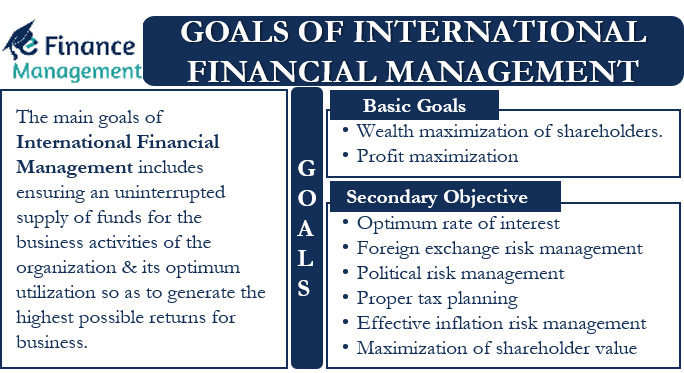
Just like domestic financial management, the goal of International Finance is also to maximize the shareholder’s wealth. The goal is not only limited to the ‘Shareholders’ but extends to all ‘Stakeholders’ viz. employees, suppliers, customers, etc. No goal can be achieved without achieving the welfare of shareholders. In other words, maximizing shareholders’ wealth would mean maximizing the price of the share. Here again, comes a question of whether in which currency should the value of the share be maximized? This is an important decision to be taken by the management of the organization.

International Business

International level initiatives like General Agreement on Trade and Tariffs (GATT), The North American Free Trade Agreement (NAFTA), World Trade Organization (WTO), etc., have promoted international trade and given it a shape. All because of liberalization and those international agreements, we have a buzzword called “MNC,” i.e., Multinational Corporation. MNCs enjoy an edge over other normal companies because of their international setting and best opportunities.

Such initiatives help a business to operate globally with ease. It also helps in the smooth exchange of goods and services internationally.

International Markets

International finance has become an important wing for all big MNCs. Without the expertise in international financial management, it can be difficult to sustain in the market because international financial markets have a totally different shape and analytics compared to the domestic financial markets. Sound management of international finances can help an organization achieve the same efficiency and effectiveness in all markets.

International Banking

It is nothing different but a general banking service that facilitates transactions within a company or among different companies internationally. Since different countries have different currencies with different exchange rates. International banking service facilitates this exchange at different rates.

Incoterms

Incoterm or International Commercial Terms are the terms one uses in international business. These terms explain the obligations and rights of the parties importing and exporting the goods regarding the pickup and delivery points. These terms require acceptance and cooperation from both parties as these are not mandatory rules.

International Trade

International trade is basically international business at the country level. Hence, it is a broader concept in comparison with international business as there is a vast difference between both of them. It directly has a link with the economic environment of a country. It determines how international business contributes to the growth of a country’s economy.

Sanjay Borad

Sanjay Bulaki Borad

MBA-Finance, CMA, CS, Insolvency Professional, B'Com

Sanjay Borad, Founder of eFinanceManagement, is a Management Consultant with 7 years of MNC experience and 11 years in Consultancy. He caters to clients with turnovers from 200 Million to 12,000 Million, including listed entities, and has vast industry experience in over 20 sectors. Additionally, he serves as a visiting faculty for Finance and Costing in MBA Colleges and CA, CMA Coaching Classes.

Unilateral Transfer

Unilateral Transfer – Meaning, What it Includes, and More

Unilateral Transfer means the one-way transfer of an item from one person to another. Such one-way transfers are without any expectations of anything in… Read Article

Last Updated on: June 27, 2022
Official-Reserve-Assets

Official Reserve Assets – Meaning, Types, Uses, and More

Official Reserve Assets are the financial assets of a country. These assets are denominated in foreign currency and are usually held by the country’s… Read Article
Last Updated on: August 16, 2022
Goals of International Financial management

Goals of International Financial Management

What is International Financial Management? Financial Management is the branch of management that takes care of the financial resources and aspects of a company.… Read Article
Last Updated on: June 13, 2022
Official Reserve Account

Official Reserve Account – Meaning, Importance, and More

The official reserve account is a term used to denote the account where all sorts of reserves are held by the monetary authorities or… Read Article
Last Updated on: October 1, 2022
Competitive Advantage vs Comparative Advantage

Competitive Advantage vs Comparative Advantage – All You Need to Know

Competitive Advantage and Comparative Advantage are concepts of economics. Both the concepts play an important role in the decision-making of a country (and company)… Read Article
Last Updated on: June 13, 2022
Soiled BOL

Soiled Bill of Lading – Meaning, How to Prevent and More

A Bill of Lading is a very crucial document in international trade. It serves as a receipt, as well as the contractual undertaking between… Read Article
Last Updated on: June 13, 2022
To Order BOL

To Order Bill of Lading – Meaning, Importance, Types, and More

Bill of Lading is a very crucial transport document in international trade. This document works as a receipt, as well as confirms the details… Read Article
Last Updated on: June 13, 2022
Stale BOL

Stale Bill of Lading – Meaning, Example, Importance, and More

A Stale Bill of Lading is a unique type of bill of lading. As the name suggests, stale means expired, time period or date… Read Article
Last Updated on: June 13, 2022
Multimodal BOL

Multimodal Bill of Lading – Meaning, What it Includes, and More

If a business undertakes exporting activities, then it has to deal with several types of documents. And one of the most crucial documents that… Read Article
Last Updated on: June 13, 2022
Through BOL

Through Bill of Lading – Meaning, Benefits and More

Exporting goods overseas involves a lot of documents, and one such important document is the Bill of Lading or BOL. Understanding and knowing about… Read Article
Last Updated on: June 13, 2022
Inland BOL

Inland Bill of Lading – Meaning, Importance and More

International trade involves a lot of processes that businesses need to take care of. One such process is shipping the goods, and the Bill of… Read Article
Last Updated on: June 13, 2022
Older posts
Newer posts
← Previous Page1 … Page4 Page5 Page6 … Page9 Next →
+ Load More Articles
Generic selectors
Exact matches only
Search in title
Search in content
Post Type Selectors

Popular Posts

  • Difference between Financial and Management Accounting
  • Capital Structure and its Theories
  • Difference between Hire Purchase vs. Installment Purchase System
  • Investment Appraisal Techniques
  • Advantages and Disadvantages of Leasing
  • Capital Structure Theory – Modigliani and Miller (MM) Approach

Recent Posts

  • The Insolvency and Bankruptcy Code of India, 2016 (IBC, 16)
  • Financial Challenges Faced by Small Businesses
  • Purpose and Application of Options
  • Bargain Purchase Option in Lease: Meaning, How it Works
  • Dividend Recapitalization (With Example)

Categories

Financial Management Concepts In Layman Terms

  • About Us
  • Contact Us
  • Site Map
  • Terms of Use
  • Privacy Policy
  • Ethics & Diversity Policy
  • Publishing Principles
Copyright © 2009-2026 eFinanceManagement.com
Next Page »